
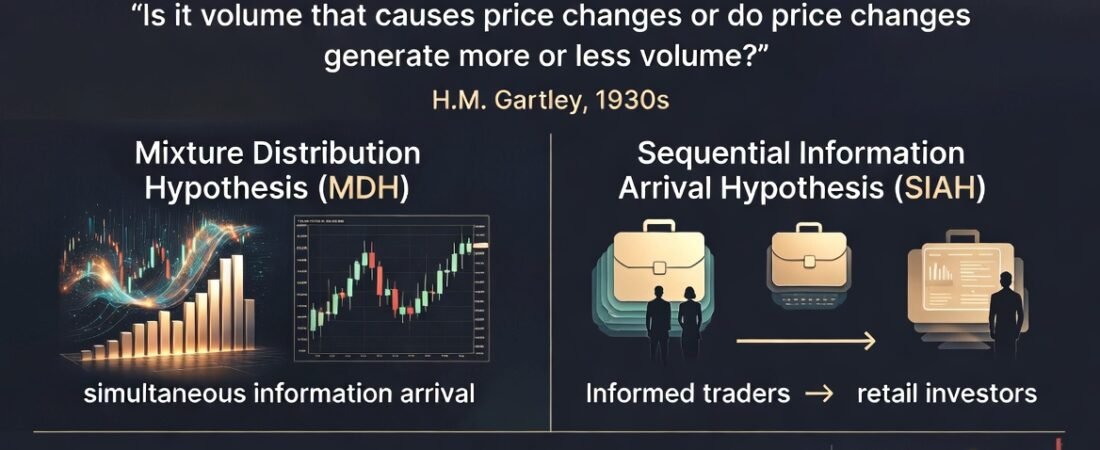
One of the principal founders of exchange flow analysis, H.M. Gartley, formulated this question in the nineteen-thirties: “Does volume determine changes in quotations, or do price changes generate an increase or decrease in trading activity?” No elementary solution exists for this question. Recent academic research has advanced several hypotheses: The MDH model holds that information reaches the market in a nearly simultaneous fashion and produces almost concurrent effects on both volumes and transaction prices. This concept suggests that flows cannot forecast future price movements, as no appreciable delay is present.
An alternative hypothesis, namely the one concerning the progressive arrival of information (SIAH), maintains that not all participants receive information with equal speed and therefore a trade-off can be expected in the period when informed operators act and subsequently uninformed ones react. Informed operators are those equipped with essential corporate data or statistics on non-public order flows.
This framework has long been assessed by global trading experts and forms the basis of numerous technical tools reliant on volume movements. It is a common view that the broader the divergence of opinions on the information reaching market participants, the greater the resulting instability and trading volume generated.
Since informed operators are by nature more current and thus less impacted by news as it disseminates, they contribute far less to excess instability than smaller investors who are typically uninformed.
The misinterpretation of information therefore drives uninformed participants to adjust their positions, which in turn would generate instability with activity peaks over short intervals, usually measured in hours or at most a few days.
Empirical checks indicate that quotation instability leads to increased trading by retail investors rather than the converse, while in professional environments the opposite holds true, featuring clear price movements induced by volume flows. The opportunity for thorough volume examination is thus aimed at narrowing the divide between the actions of major participants and the responses of smaller ones, fully benefiting the latter’s accurate reaction to institutional attempts to distort the market.