
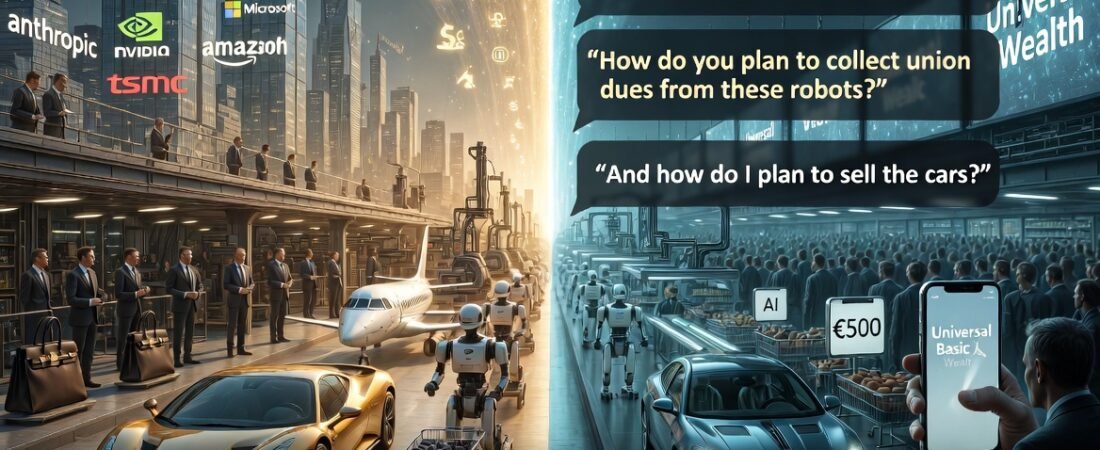
If artificial intelligence displaces the entire human workforce, which economic agents will sustain aggregate demand for goods and services?
This objection appears systematically beneath every post I publish on AI—hundreds of variants each week, phrased in countless ways, yet invariably the same core question. And it is, without doubt, the sharpest issue in the entire macroeconomic debate on the impact of artificial intelligence.
A question so prescient that it was, in fact, posed seventy years ago.
Cleveland, Ohio, 1954. Ford inaugurates the first fully automated engine plant in history. A senior executive escorts Walter Reuther, president of the United Auto Workers union, on a guided tour. Standing before the operatorless production lines, the executive quips: “Walter, how do you plan to collect union dues from these robots?”
Reuther replies without hesitation: “And how do you plan to sell the cars?”
In seventy years of academic literature, conferences, and publications, no response has surpassed in clarity the retort of a 1954 union leader.
Yet the Ford automated facilities remain operational, automobiles continue to be sold, and the economic system has not collapsed.
Today the scenario repeats itself on a scale ten times larger.
Dario Amodei, CEO of Anthropic—the company that has just closed a $30 billion funding round at a $380 billion post-money valuation—publicly forecasts that within five years 50% of white-collar entry-level roles will be eliminated, producing an unemployment rate of 10–20%. For context, the Great Depression of 1933 peaked at 25%.
Jack Dorsey cut Block’s headcount by 40%, explicitly citing AI as the efficiency driver. Oracle eliminated 30,000 positions in a single tranche. In the first quarter of 2026 alone, the global technology sector shed between 78,000 and 90,000 jobs.
Amodei issues these warnings while marketing the very AI responsible for the layoffs, appearing live on CNN without reservation.
By this point, readers likely expect either the familiar “the system will collapse” or the reassuring “we will adapt as always.” Neither thesis will be offered. The question deserves a more rigorous analysis.
The response is therefore structured along four fronts, ordered by increasing degree of discomfort.
1. The true buyer is not the retail consumer.
Eighty percent of Anthropic’s revenue derives from corporate clients. The proportion is comparable for OpenAI. The bulk of cash flows generated by general-purpose AI foundation models originates in B2B, not B2C, channels.
Microsoft purchases models from Anthropic. Anthropic purchases cloud capacity from Amazon Web Services. Amazon purchases GPUs from NVIDIA. NVIDIA purchases wafers from TSMC. This is a closed-loop chain of inter-company transactions that self-sustains.
Even if the individual consumer loses employment and wage income, the AI ecosystem can continue expanding for years because its primary buyers are other enterprises deploying the technology to compress labor OPEX and expand operating margins.
The outcome is not socially desirable, but it is the market equilibrium now materializing.
2. Wealth concentration and polarization of consumption demand.
When 100 employees earning an average annual salary of €50,000 are replaced by an AI whose annual cost is €500,000, the economic value created does not vanish: it concentrates in the hands of equity holders, senior management, and owners of the software and intellectual property.
Hermes generated €15 billion in luxury handbag revenue while fast-fashion operators accumulate unsold inventory for clearance. Ferrari posts record sales and deliveries year after year. Private-jet order books show three-year waiting lists.
Mass-market consumption contracts; the ultra-high-net-worth and luxury-consumption segment explodes, supporting an ever-larger share of aggregate demand.
3. Generalized deflationary effect induced by AI.
A mid-range vehicle of Chinese manufacture currently costs approximately €8,000. Within five years an automobile fully designed, assembled, and tested by AI systems could fall to €3,000; within ten years, potentially to €500.
The same mechanism applies to food, apparel, electronics, pharmaceuticals, and software. Any good priced at 100 today will be commercialized at 10 tomorrow—not because individual purchasing power collapses, but because the marginal cost of production approaches zero.
In 1900 an American farmer allocated 80% of income to food; today the average citizen allocates 10%. The same phenomenon, different scale.
Consequently, even an individual without wage income but receiving minimal public transfers will gain access to goods and services now regarded as luxuries.
4. Compensatory public intervention: Universal Basic Wealth as an administrative stabilization tool.
Sam Altman states this openly in conferences and podcasts, advocating what he terms “Universal Basic Wealth.” Translated from Altman-speak into financial terminology: a monthly cash transfer conditioned on the preservation of social cohesion.
This will not be a Hollywood-style dystopia. It will be a technocratic-administrative scenario.
Citizens will receive a calibrated basic income set at a dignified subsistence level. They will purchase deflated goods at near-zero marginal cost, unlimited digital content, and all-you-can-consume entertainment platforms. The day will be saturated with free or nearly free consumption options.
The result will not be absolute poverty, but economic irrelevance—a far more critical distinction.
Because when income depends on a unilaterally disbursed government cheque, economic freedom shrinks to a menu of pre-defined options chosen by the central authority.
Synthesis of the new market equilibrium.
The system does not collapse: it bifurcates.
On one side, the class of owners of productive assets—a small minority—holds equity in enterprises, brands, real estate, software, intellectual property, and monetizable reputation. They live on positional rents and shape the direction of consumption because they control its supply. They are the rentiers of the twenty-first century.
On the other side, the administered masses—the majority—live on public transfers, consume deflated goods and free content, possess everything required for subsistence and nothing that would enable them to act as autonomous economic agents.
The intermediate band—the middle class that enjoyed seventy years of Western prosperity through white-collar employment—contracts gradually. It does not disappear overnight; it erodes generation after generation.
Statistically, your children will land either above or below this bifurcation. The mathematics of capital returns relative to labor returns suggests that the median probability is to end up below.
It is at this point that the original comment-section question ceases to be the relevant one.
“Who will buy the products?” is the perspective of the employee: the person on the other side of the desk who receives a paycheck and wonders every morning how long it will last.
The entrepreneur, investor, and builder ask a different, more strategic question: “Which side of the bifurcation do I want to occupy?”
The answer is clear. To position oneself in the upper tier requires ownership of something machines cannot replicate. A company is one option, yet enterprises are being consolidated by large players at unprecedented speed. A brand, a built reputation, a name associated with specific, market-recognized competence offers a far more durable barrier to entry.
Reuther was fundamentally right on one point: robots do not buy cars.
He was wrong, however, on everything else. Cars will still be sold—indeed, in greater volumes than before—but the consumer of tomorrow will not be the consumer of yesterday, and the queue at the dealership will not be the one expected.
The free market is an extraordinarily resilient mechanism. It never dies. It merely changes its skin. Every twenty to thirty years it reinvents itself, eliminating those who had grown comfortable on positional rents and rewarding those who understood the new map ahead of time.
The question that matters is no longer “Who will buy the products?”
It is: “Within this new market structure, what will you have to sell?”