
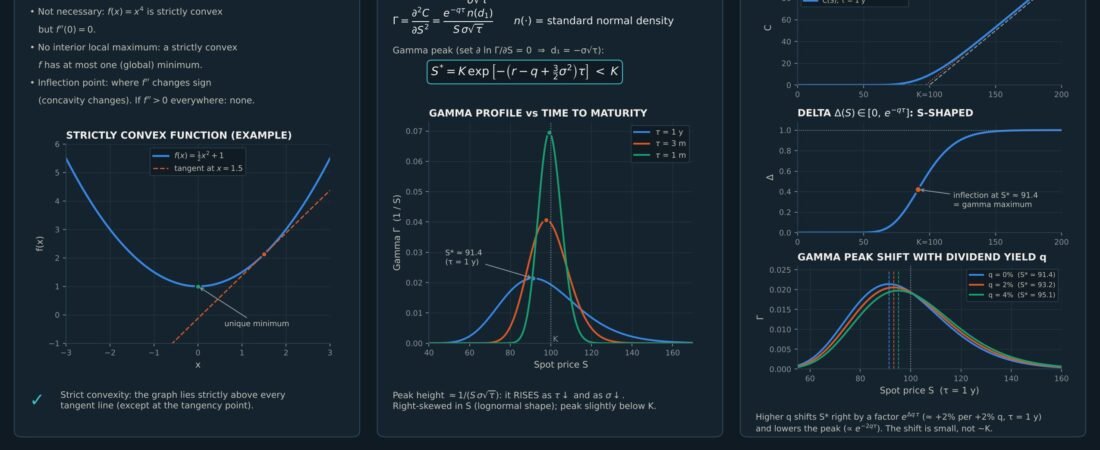
Convexity Without Inflection Points
The Black–Scholes Gamma and Its Peak
A Rigorous Mathematical and Financial Analysis of Option Price Curvature, Delta Inflection, and
Dividend Dynamics
EXECUTIVE SUMMARY & CORE FINDINGS
- Strict Price Convexity: In the Black–Scholes–Merton model, vanilla European call and put options are
strictly convex with respect to spot price S across (0, ∞). Option price V(S) possesses no inflection
points. - Universal Positivity of Gamma: Gamma (Γ = ∂²V/∂S²) is strictly positive for all S > 0, both with zero
dividends (q = 0) and continuous dividend yield (q > 0). - Gamma Peak vs. Price Inflection: The point where Gamma is maximized (S_Γmax) is NOT an
inflection point of option value V(S). Instead, it represents the exact inflection point of Delta (Δ). - Exact Peak Location: The Gamma peak occurs below the forward price at S_Γmax = K · exp[-(b +
3/2·σ²)T]. The common heuristic ‘Gamma is maximized At-The-Money’ is only a crude approximation.
- Introduction and Perceived Convexity
When inspecting the price profile of a vanilla European call option plotted against the underlying asset
price S, observers intuitively notice a characteristic shape: the curve initiates near zero for out-of-the-
money spot levels, accelerates sharply around the strike price K, and gradually flattens into an almost
linear trajectory deep in-the-money. Visual inspection often leads market practitioners to interpret this
‘knee’ as an inflection point where curvature changes direction.
However, this visual intuition is mathematically incorrect. In the Black–Scholes–Merton (BSM)
framework, a European vanilla call or put option has no inflection point with respect to S. The option
value function V(S) remains strictly convex across the entire positive domain (0, ∞). Gamma (Γ) never
vanishes and never changes sign.
The special point commonly calculated in quantitative risk management is something else entirely: it is
the maximum of Gamma (where Speed ∂Γ/∂S = 0), which coincides with the inflection point of Delta (Δ),
rather than that of the option premium. - Mathematical Definition of Inflection — Why V(S) Has None
By formal calculus, a twice-differentiable function V(S) exhibits an inflection point at S₀ if and only if two
conditions are met:
- The second derivative vanishes: Γ(S₀) = ∂²V / ∂S² |S=S₀ = 0
- Gamma changes sign across S₀ (transitioning from convex Γ > 0 to concave Γ < 0, or vice versa).
For vanilla European options, this requirement is never satisfied, whether under zero dividends (q = 0) or
continuous dividend yields (q > 0). The visual perception of an inflection is an optical illusion created by
the asymptotic limits Γ → 0 as S → 0⁺ and S → +∞. Far from moneyness, the curvature becomes
imperceptibly small, yet the curve remains strictly bent upwards throughout. - Analytical Formulas and Formal Proof of Positivity
Consider a European call C and put P written on an asset with spot price S, strike K, time to expiry T, risk-
free rate r, continuous dividend yield q, and volatility σ. The Black–Scholes–Merton pricing equations
are:
C = S · e⁻��ᵀ · N(d₁) – K · e⁻ʳᵀ · N(d₂)
P = K · e⁻ʳᵀ · N(-d₂) – S · e⁻��ᵀ · N(-d₁)
where the standardized d-terms are defined as:
d₁ = [ ln(S / K) + (r – q + ½σ²)T ] / (σ √T)
d₂ = d₁ – σ √T
Put-Call Parity and Gamma Symmetry
From Put-Call Parity with continuous dividends:
C – P = S · e⁻��ᵀ – K · e⁻ʳᵀ
Because the right-hand side is a linear (affine) function of S, its second derivative with respect to S is
identically zero. This proves that call and put Gamma are strictly identical:
Γ_C = ∂²C / ∂S² = ∂²P / ∂S² = Γ_P
Explicit Gamma Formula
Differentiating the Call Delta Δ_C = e⁻��ᵀ · N(d₁) with respect to S yields the closed-form expression for
Gamma:
Γ = [ e⁻��ᵀ · n(d₁) ] / (S σ √T)
where n(x) = (1 / √(2π)) · exp(-x² / 2) denotes the standard normal probability density function.
Formal Positivity Proof
For any valid financial parameters (S > 0, T > 0, σ > 0):
- Discount/Dividend Factor: e⁻��ᵀ >
- Denominator: S · σ √T > 0
- Gaussian Density: n(d₁) > 0 for all real numbers d₁ ∈ ℝ
Consequently, Γ(S) > 0 for all S ∈ (0, ∞). Gamma is strictly positive, proving that option price V(S) is
strictly convex and possesses zero inflection points.
- Derivation of the Gamma Peak and Speed
Although Gamma never reaches zero, it attains a unique global maximum. To derive the spot location
S_Γmax where Gamma is maximized, it is mathematically convenient to maximize ln(Γ):
ln(Γ) = C_const – ln(S) – ½ (d₁²)
Recalling that ∂d₁ / ∂S = 1 / (S · σ √T), taking the derivative of ln(Γ) with respect to S yields:
∂ ln(Γ) / ∂S = – (1 / S) – [ d₁ / (S · σ √T) ] = 0
Setting the derivative to zero gives the critical peak condition:
d₁ = – σ √T
Substituting the definition of d₁ into this condition:
[ ln(S / K) + (r – q + ½σ²)T ] / (σ √T) = – σ √T
ln(S / K) + (r – q + ½σ²)T = – σ² T
ln(S / K) = – (r – q + 3/2·σ²)T
Exponentiating both sides yields the exact analytical spot price for maximum Gamma:
S_Γmax = K · exp[ – (r – q + 3/2·σ²) T ]
In terms of the cost-of-carry parameter b = r – q:
S_Γmax = K · exp[ – (b + 3/2·σ²) T ]
Speed and Delta Inflection Interpretation
The derivative ∂Γ / ∂S is known in exotic Greek risk management as Speed. At S_Γmax, Speed vanishes
(∂Γ / ∂S = 0). Because Gamma is the derivative of Delta (Γ = ∂Δ / ∂S), we have:
∂²Δ / ∂S² = ∂Γ / ∂S = 0
Therefore, S_Γmax is the inflection point of Delta (Δ), marking where Delta transitions from convex
(accelerating growth) to concave (decelerating growth towards its asymptote). It is not an inflection
point of the option value V(S).
5. Mathematical Overview and Comparison Table
Analytical Object Vanishing Derivative Financial & Geometric
Interpretation
Inflection Point of V(S) Γ = ∂²V / ∂S² = 0 Does NOT exist for European
vanilla options. Option price is
strictly convex everywhere (Γ > 0).
Maximum of Gamma Γ(S) Speed = ∂Γ / ∂S = 0 Unique global peak occurring at
S_Γmax = K · exp[-(b + 3/2·σ²)T].
Critical for peak Gamma hedging.
Inflection Point of Delta Δ(S) ∂²Δ / ∂S² = ∂Γ / ∂S = 0 Coincides EXACTLY with the
Gamma peak. Delta transitions
from accelerating to decelerating
growth.
- Empirical Rule vs. Exact Solution: Numerical Case Study
A widespread market heuristic suggests that ‘Gamma is maximized At-The-Money (ATM)’. In reality, this
is only a rough approximation. The exact peak lies strictly below the forward price F = S · e^{(r-q)T},
displaced downward by the variance adjustment term -3/2·σ²T. Higher volatility σ shifts the peak further
downward away from the strike.
NUMERICAL CASE STUDY PARAMETERS & RESULTS
- Strike Price (K): 100
- Time to Expiry (T): 1.0 year
- Risk-Free Interest Rate (r): 5.0%
- Continuous Dividend Yield (q): 2.0%
- Volatility (σ): 20.0%
- Cost of Carry (b = r – q): 3.0%
- Calculated Gamma Peak Spot (S_Γmax): 100 · exp[- (0.03 + 0.06)] = 100 · exp[-0.09] ≈ 91.39
- d₁ at Gamma Peak: d₁ = -σ √T = -0.20
- Gamma at Peak: Γ(91.39) ≈ 0.0210
- Gamma At-The-Money Spot: Γ(K = 100) ≈ 0.0190
- Forward Price (F): F = 91.39 · e^{0.03} ≈ 94.18 (Spot 91.39 is far below ATM 100)
As demonstrated by the numerical case study, Gamma at S = 91.39 is Γ ≈ 0.0210, which is significantly
higher than the ATM spot Gamma Γ(100) ≈ 0.0190 (a ~10.5% difference). Traders relying strictly on ATM
spot metrics will systematically misestimate their maximum Gamma risk exposure.
7. Graphical Panel Interpretation
Analyzing a standardized three-panel option metric chart reveals the clear mathematical story:
- Panel 1 (Option Value V(S)): The call option curve sits strictly above its intrinsic arbitrage bound
max(S · e⁻��ᵀ – K · e⁻ʳᵀ, 0). It exhibits continuous positive curvature and never reverses convexity. - Panel 2 (Gamma Γ(S)): Gamma forms a smooth, strictly positive bell curve peaking at S ≈ 91.39. It
approaches zero asymptotically at both boundaries without ever crossing zero. - Panel 3 (Delta Δ(S)): Delta is a monotonically increasing S-shaped curve from 0 to e⁻��ᵀ. It changes
concavity precisely at S_Γmax ≈ 91.39—confirming that this location is the genuine inflection point
of Delta, not of the option premium.
- Financial and Trading Risk Implications
Understanding the non-existence of premium inflection points and the precise location of the Gamma
peak carries essential practical implications for derivative trading and risk management:
- Long Vanilla Positions (Always Long Gamma): In Black–Scholes, a long vanilla option holder is
universally long Gamma (Γ > 0). Dynamic delta hedging requires buying the underlying asset as spot
drops and selling as spot rises to rebalance the hedge. This mechanical rebalancing is the source of
the classic Theta–Gamma trade-off (paying time decay to capture volatility gains). - Short Vanilla Positions (Always Short Gamma): An option writer is universally short Gamma (Γ <
0). The option payoff is a strictly concave function of spot, exposing the market maker to
accelerating losses during extreme market moves. - Pin Risk and Expiration Dynamics (T → 0): As time to expiry approaches zero (T → 0), the variance
term -3/2·σ²T vanishes, causing S_Γmax to converge directly onto strike K. Concurrently, the Gamma
peak height diverges to infinity while narrowing into a Dirac delta function—creating extreme ‘pin
risk’ for options near the money. - Where CAN Variable-Sign Gamma Occur? True option price inflection points (where Gamma
changes sign) do exist in non-vanilla contexts: barrier options, cliquet options, digital/binary options,
American options near early exercise boundaries, or option portfolios with mixed long/short
positions. Furthermore, models featuring non-lognormal risk-neutral distributions (such as jump-
diffusion or local volatility models calibrated to market volatility smiles) can generate option price
inflection points. For vanilla European options under Black–Scholes, however, Gamma is universally
positive and $V(S)$ is strictly convex.