
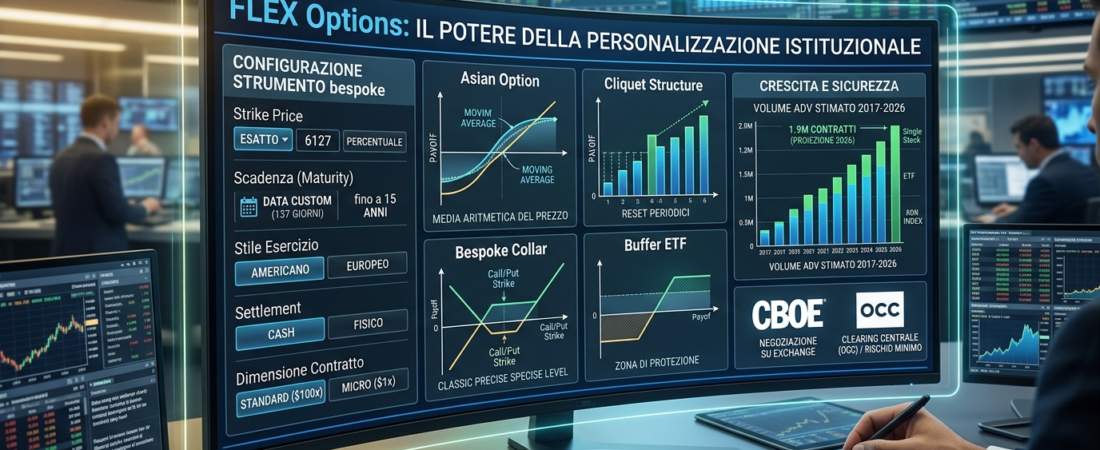
FLEX Options: Financial Engineering and Customization in the Institutional Segment
FLEX Options (FLexible EXchange® Options) represent high-complexity derivative solutions currently undergoing significant expansion within global capital markets, primarily across the institutional sector. Introduced by the CBOE in 1993, these instruments integrate the versatility inherent in over-the-counter (OTC) contracts with the risk mitigation, transparency, and liquidity frameworks typical of regulated exchanges. They are not pure OTC instruments: trading occurs on dedicated venues (CBOE, NYSE) with centralized clearing through the Options Clearing Corporation (OCC), effectively neutralizing counterparty risk via the contract novation mechanism standard in exchange-traded markets.
As highlighted in technical frameworks (ref: slides by Fabio Gaudioso, risk management analyst), FLEX Options are bespoke tools engineered for institutional investors. By bypassing the constraints of vanilla options (predefined maturities, strikes, and exercise styles), FLEX instruments allow for the precise calibration of:
- Strike Price (exact, expressed in absolute, percentage, or relative terms);
- Maturity (flexible tenors up to 15 years, extending beyond the standard calendar);
- Exercise Style (American-style or European-style);
- Settlement (cash-settled or physical delivery for equities/ETFs);
- Contract Size (including FLEX Micros with a $1 multiplier instead of $100);
- Structured Payoffs (e.g., Asian or Cliquet structures for insurance/annuity sectors).
Operational Case Study:
While a standard SPX option follows discrete expirations and strikes, a FLEX option allows for the structuring of a 137-day tenor, a precise strike at 6127, customized settlement, and an architecture fully aligned with a fund’s specific liability profile.
Institutional Target and Adoption Drivers
FLEX Options serve as the quintessential asset management tool. According to CBOE analytics, key market participants include:
- Pension funds
- Insurance companies
- Hedge funds
- Overlay managers
- Investment Banks (for structuring purposes)
- Tier-1 Wealth managers
Strategic Objectives: Three Application Pillars (ref: Gaudioso dataset):
- Institutional Hedging
Example: A fund with $20 billion in U.S. equity exposure requires tail-risk protection at a 10% level for 9 months. Instead of utilizing inefficient standard options, it implements a bespoke collar with pinpoint strikes and maturities. This level of customization optimizes the hedge ratio while minimizing basis risk and tracking error.
- Yield Enhancement (Volatility Monetization)
Numerous funds execute FLEX call writing strategies on managed portfolios. This generates alpha through premium collection (selling implied volatility), optimizing Total Return without liquidating underlying assets. This represents a systematic “overlay” model deeply rooted in the institutional space.
- Structured Products
Investment banks utilize FLEX Options to engineer:
- Certificates / Autocallables
- Principal Protected Notes
- Buffer ETFs / Target Outcome strategies
- RILAs (Registered Index-Linked Annuities).
FLEX Options replicate exotic payoffs (Asian, Cliquet) within a regulated ecosystem.
Volume Dynamics: Structural Evolution
The “Avg Daily FLEX Volume by Type” (2017–2026) data indicates parabolic growth, driven by the Single Stock and ETF segments, with Index volumes consolidating.
- 2026 Projection: FLEX ADV estimated at 1.9 million contracts (2.7% of total Listed ADV).
- Breakdown: Single Stock ~1.2M | ETF ~678K | INDEX ~32.6K.
2025 Metrics (Source: CBOE):
- FLEX ADV ≈ 1.4 million contracts (+62% YoY, 10x higher than 2019).
- Single Stock dominance (958K), followed by ETFs (301K) and Indices (29K).
- FLEX Open Interest surged from ~6.15M to over 38–47 million contracts (reflecting the expansion of institutional overlay).
These systemic flows impact dealer inventories, necessitating the dynamic management of Greeks (gamma, vanna, charm, skew). Such volumes increasingly influence market microstructure and the volatility dynamics of the SPX index.
FLEX vs. OTC: The Superiority of Regulated Markets
| Variable | FLEX Options | OTC Instruments |
| Bespoke Features | High (strike, maturity, payoff) | Maximum |
| Counterparty Risk | OCC Clearing (AAA rated) | Bilateral Default Risk |
| Transparency | Competitive Auction / Quoted | Private Negotiation |
| Liquidity | Institutional Market Makers | Dealer Discretion |
| Capital Efficiency | Novation & Cross-margining | Bilateral Margins (ISDA) |
| Regulatory Framework | Exchange-Listed Regulation | Less Transparent |
| Accessibility | Institutional Brokers | Direct Agreements (ISDA) |
FLEX Options were designed to internalize the OTC market by offering operational flexibility coupled with clearinghouse guarantees.
Innovations and Strategic Outlook
- FLEX Micro (2022): Unitary multiplier for granular hedging (optimal for the insurance sector).
- FLEX Complex Orders: Integration of FLEX legs and listed options within a single strategy.
- Cboe Europe Derivatives: European rollout scheduled for Q1 2026 (critical for EU-based investors).
- Increased adoption in Buffer ETFs, target outcome funds, and retirement products.
Conclusions: A Strategic Institutional Asset
FLEX Options are not retail instruments; they require advanced expertise in Greeks and access to institutional desks. For funds, insurance companies, and banks, they represent the gold standard for precision hedging, yield generation, and bespoke product structuring. The explosive growth in volume marks the transition of FLEX Options from a niche tool to a structural pillar of the derivatives market. This trend is set to persist, driven by cross-border expansion and continuous product innovation from the CBOE.