
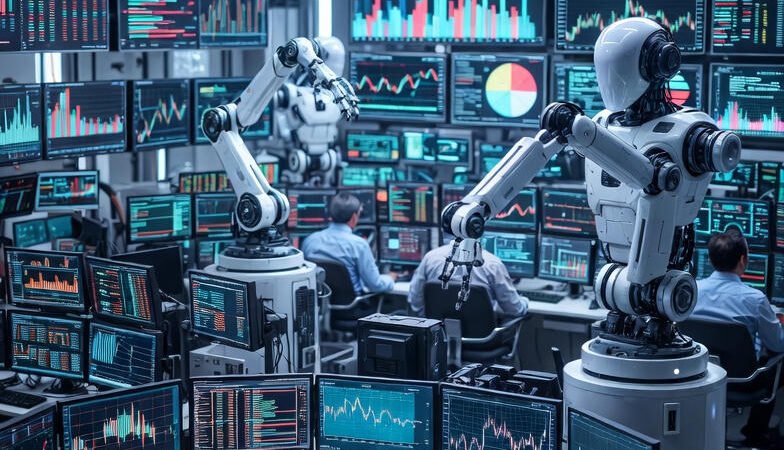
The End of Traditional Trading
Executive Summary
The financial markets are undergoing a paradigm shift driven by technological advancements, rendering conventional trading methodologies obsolete. This document elucidates the disruptive influence of artificial intelligence (AI), high-frequency trading (HFT), and zero-days-to-expiration options (0DTE) on market dynamics. It posits that human traders are increasingly marginalized in an ecosystem dominated by algorithmic efficiency, computational superiority, and relentless automation. The strategic imperative is to leverage residual market inefficiencies during this transitional phase to maximize alpha generation and capital accumulation before full AI hegemony.
The Market’s Absolute Manipulation
“The market is already the most manipulated in absolute terms.”
— Excerpt from a dialogue with institutional traders.
This assertion underscores the pervasive role of algorithmic interventions in distorting price discovery processes, where HFT firms exploit latency arbitrage and order flow manipulation to achieve informational asymmetry over retail and traditional participants.
The Perfect Storm: Emerging Market Dominators
High-Frequency Trading (HFT)
The genesis of ultra-low-latency execution. These systems operate on microsecond timescales, obsoleting human intervention in short-term time frames by capitalizing on fleeting market inefficiencies through co-location and microwave transmission networks.
Zero-Days-to-Expiration Options (0DTE)
The accelerator of market complexity. These instruments have rendered short-term dynamics unpredictable and catastrophic for legacy analytical frameworks, amplifying gamma squeezes and volatility clustering due to their high leverage and intraday expiration.
Artificial Intelligence (AI)
The exponential power multiplier. This intelligence analyzes, learns, and executes on a scale inaccessible to humans, employing machine learning models for predictive analytics, sentiment analysis, and adaptive strategy optimization across vast datasets.
The Market at Warp Speed
Market transformation is evident daily. Tasks that once demanded the labor of hundreds are now automated via algorithmic trading platforms.
Technology is already deployed to slash analysis timelines: from hours to mere seconds, leveraging big data processing and neural networks for real-time risk assessment and portfolio rebalancing.
Legacy Frameworks No Longer Viable
The widespread adoption of 0DTE options has invalidated numerous classical tools for short-term dynamics analysis.
✗ Daily Volume Analysis: Ineffective due to intraday noise amplification.
✗ Gamma Exposure Studies: Compromised by rapid decay and hedging cascades.
✗ Short-Term Dynamics Interpretation: Overwhelmed by volatility spikes and non-linear price movements.
Direct Confrontation: Human vs. Machine
Human Trader
- Speed: Constrained by cognitive processing latencies.
- Computational Power: Sequential, prone to behavioral biases such as anchoring and overconfidence.
- Discipline: Susceptible to emotional influences and fatigue-induced errors.
- Operational Uptime: Approximately 8 hours per day.
Machine (AI/HFT)
- Speed: Microsecond execution via field-programmable gate arrays (FPGAs).
- Computational Power: Parallel processing on massive datasets, enabling multi-factor models and deep reinforcement learning.
- Discipline: Absolute, algorithmically enforced without deviation.
- Operational Uptime: 24/7, facilitating continuous arbitrage and market-making.
Competition on speed or computational grounds is untenable; humans must pivot to higher-level strategic oversight.
The New Trader Is De Facto an AI
In essence, the contemporary trader archetype is already an AI entity, integrating predictive modeling and automated execution to dominate order books.
Current Role of Artificial Intelligence
Presently, AI does not yet serve as the primary market pilot.
However, it functions as a formidable operational adjunct. Advanced systems are operational in institutional trading, executing tasks with superior precision and velocity compared to human counterparts, including pattern recognition, anomaly detection, and high-dimensional data correlation.
An Unequivocal Trajectory
The evolution of AI tools in trading is remarkable. The trajectory is unambiguous:
Operational Support → Strategic Co-Pilot → Primary Pilot
Ultimate destination: Ubiquitous AI integration, encompassing autonomous portfolio management and dynamic hedging algorithms.
Personal Impact
The trader’s profession ranks among those most vulnerable to obsolescence.
Activities that historically conferred professional edge—such as technical analysis and discretionary decision-making—are now performed by machines with markedly superior efficacy, leveraging unsupervised learning to adapt to regime shifts.
The Final (Temporary) Competitive Edge
Notwithstanding the above, traditional analysis retains utility when applied judiciously.
✓ Management of movements in significant strategies, focusing on macroeconomic indicators and event-driven trades.
✓ Execution when markets reach predefined key levels, such as support/resistance zones or Fibonacci retracements.
✓ Augmenting operations on major U.S. equities in specific contexts, like earnings volatility plays.
“These are dynamics that have been functional for nearly three years.”
Logic of the Current Context
Given the inexorable transition to an AI-dominated market, the rational strategy eschews resistance in favor of exploiting lingering inefficiencies.
- Exploit Dynamics While They Persist Maximize profits from still-viable strategies, emphasizing mean-reversion trades and momentum continuation.
- Accumulate Maximally Utilize this opportunity window to build capital reserves, preparing for diversification into AI-augmented investment vehicles.
Battle Plan Synthesis
The Reality
AI and HFT already own the market in terms of latency, complexity, and computational prowess. Traditional instruments are inefficacious for short-term horizons, failing to account for flash crashes or liquidity vacuums.
The Risk
The human trader’s role, as conventionally understood, is en route to extinction. Direct competition with machines is infeasible due to insurmountable asymmetries in processing speed and error rates.
The Strategy
Exploit to the utmost, and as long as feasible, the final market inefficiencies at key levels and broader-respiration strategies. Accumulate resources for reinvestment in algorithmic funds or quantitative strategies.
Concluding Insight
It is not a question of if AI will assume control, but of how we navigate the transition—potentially through hybrid human-AI models or upskilling in quantitative finance.